Garden Organization
- Matthew Forster

- 12 minutes ago
- 4 min read
I have been a gardener for a long time, here and there. This year I decided to get serious about it. I have the time, the space, and I am still able-bodied enough to dig in the dirt.
I also have ADHD, and historically I am not that great at keeping myself organized. I tend to do things in fits and starts, which leads to inconsistent plants and a not great harvest.
This year, getting serious meant getting organized. And so I created a system that works for me, and I will now share it with you! Be warned: none of it is digital.

First of all, I have no garden shed or easy access to our garage. So I had to figure out a system of keeping things either on the deck, under the deck, or inside the house.
A dedicated and labelled space for seeds and seed accoutrements. I have a small tupperware bin, and inside I keep smaller containers with seeds to plant soon, seeds to plant later, and seeds to plant next year. I also have a seed sowing tool, a garden marker (so it won't fade in the sun like a sharpie will), and many plant tags.
Hand tools and gloves kept in a basket, on the shelf near my back door. This keeps the leather away from our dog, who will eat anything made from leather the second he gets his little paws on it, and keeps it convenient for me to grab on my way out the door.
Potting soil, seed starting mix, and succulent mixes in their own bins on our large back deck. I always know how much I have this way.
Nursery pots, decorative containers, watering cans, plant stakes, plant clips, floating row covers, and bag clips are kept on the deck as well. Larger containers are kept under the deck.
Trellis materials, fencing, t-posts, large bags of topsoil and mulch: all under the deck.
Long-handled tools (such as spades and edgers) and electric tools (hedge trimmers, weed wacker, lawn mower) are all kept in the garage. Batteries are organized at a charging station, so I always have a new battery to grab.
Wheelbarrows are kept either under our big trellis or under the deck.
My handmade wisteria basket that I use for harvesting lives on the deck. It will get heavy use later in the season and right now it just looks pretty.
And finally, the most important thing: the binder.
The binder is the key to all of this. I thought long and hard about this. I needed to keep track of sowing dates, fertilizer applications, future plans, frost dates, and information about plants. I also needed a place to corral my random 3am ADHD-fueled deep dives into future plans, like raising quail and building my own fencing.
AND SO:
THE BINDER!

Section 1: Quick Reference
West Coast Seeds publishes a vegetable, herb, and flower planting guide in their catalogue each year, and I always cut it out and save it. It's in a plastic sleeve.
My soil testing kit came with a quick reference for pH preferences, and I put that into a plastic sleeve.
My local regional district mailed us a nice chart with all the details for what to do at different water restriction levels. We don't normally get past stage 1 here, but it could be a different year this year.
Garden Next Steps: a checklist of things I need to do this month.
Garden Next Steps: for the following month.
Shopping List: a checklist of things I currently need to buy or acquire, like a T-post driver and 1/4" hardware cloth to make a compost sieve.
Starts to Buy: a checklist of plants I am not growing from seed, and when to buy them.
Seeds to Buy: a checklist of seeds I would like for this year.
Seed Inventory: a list of all the seeds I have, including variety name, supplier and supplier code, year purchased or collected. Organized by category (vegetable, herb, flower).
Garden Map: a not-to-scale drawing of my property with lists of plants I am growing or intend to grow, colour-coded into three broad categories: spring, summer, and fall/winter.
Section 2: Current Year
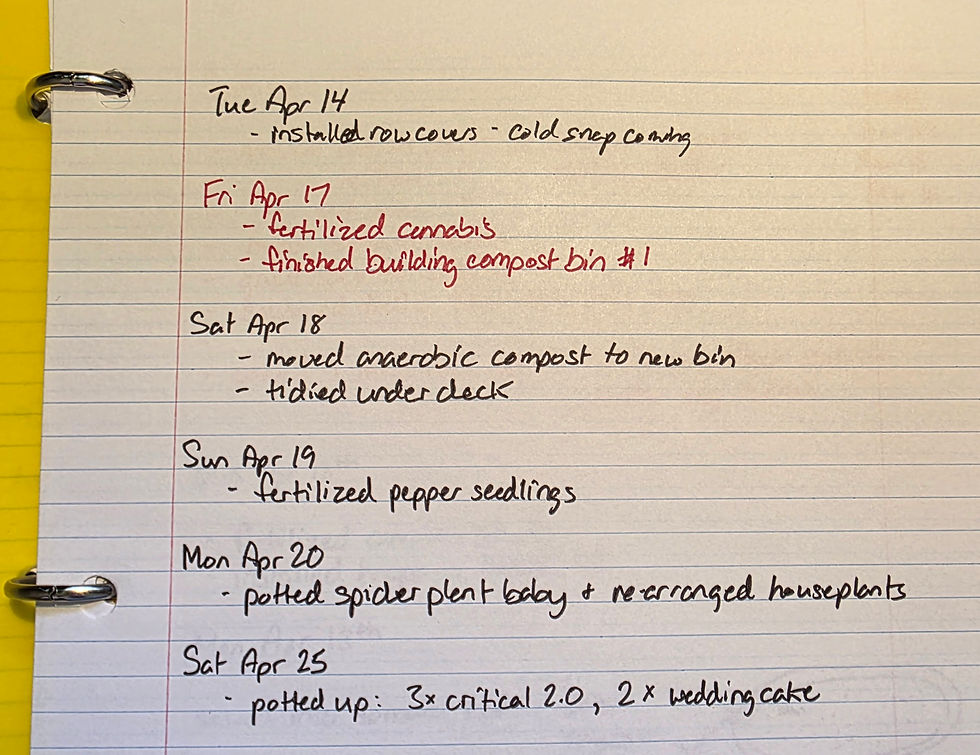
A short log, in reverse chronological order, of the things I do in the garden:
Sowing seeds
Planting starts
Harvest dates and yields
Fertilizer applications
Infrastucture improvements (installing trellises, building new beds, putting out row covers. etc.)
Interesting notes, like when something sprouted, unusual weather, pests, water restriction dates
A pencil case designed for a 3-ring binder, containing receipts from the garden store, empty seed packets used this year, and instruction manuals from equipment purchased this year.
Section 3: Foraging
A list of current season priorities
A list of future season priorities
Notes on best practices, including an outline for a zine I plan on publishing about foraging safely when one has serious food allergies
Section 4: Livestock, Building, Etc.
Building project notes, such as my future greenhouse
Livestock project notes, such as my future quail raising endeavour
Anything else that doesn't fit anywhere else (e.g.: a list of supplies needed to make mead, which is something I want to do eventually)
Section 5: Soil and Compost
Notes from a soil class I took online
Best practices for home composting
Section 6: Last Year
Last year's notes
A pencil case with receipts and empty seed packets from the last year
Section 7: Plants A-Z

An alphabetical log of all of the plants I am interested in growing. Each plant gets 1-2 pages (depending on complexity of growing) with details about soil preferences, light needs, fertilizer types, harvesting, propagation, seed saving, succession crop timing, etc.
Section 8: Next Year
A list of the plants I want to grow next year as well as their timing.
Too much? Probably yep, but this has completely saved my life this spring. It's kept me interested (organization is fun to me, and yes I know that is strange), I have something to look over at night when I am watching YouTube videos about my latest gardening interest , and I can use it to figure out where I went wrong when I inevitably go wrong with something.
If anyone out there has any advice for me, please let me know! 😀


Comments